

Antibodies are invaluable to scientific research, diagnostics, and therapeutics. These simple yet powerful scientific tools find their way into a diverse range of fields and applications. Primary antibodies bind specifically to a protein of interest (antigen). Conjugated secondary antibodies, which recognize primary antibodies, provide signal for detection. Multiple polyclonal secondary antibodies can bind to each primary, providing signal amplification compared with a directly labeled primary antibody.
What is a secondary antibody?
A secondary antibody is one that recognizes an antibody or antibody domain from a different species. Secondary antibodies are used to bind primary antibodies (specific for a protein of interest (antigen)) in many different experimental schemes. Conjugated secondary antibodies (labeled with reporter molecules such as enzymes or fluorophores) can be used to visualize the antigen. There are many applications for unconjugated secondary antibodies as well, for example, coating ELISA plates or beads for capturing and/or purifying primary antibodies.
Direct and indirect detection
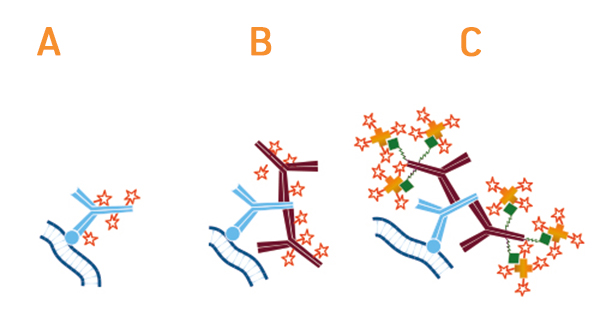
Fig 1: A: Direct immunohistochemistry (IHC); B: Indirect IHC; C: Signal enhancement with biotinylated secondary antibody and conjugated streptavidin.
Fig 1A: A directly conjugated primary antibody binds specifically to the protein of interest (antigen); Fig 1B: Multiple conjugated secondary antibodies bind to each primary antibody, amplifying signal; Fig 1C: Further signal enhancement is achieved by using a biotinylated secondary antibody, followed by a conjugated streptavidin.
Why use secondary antibodies?
The indirect method using a secondary antibody offers many advantages over the direct method.
- Inherent signal enhancement – Multiple secondary antibodies bind to one antigen-bound primary antibody, bringing additional reporter molecules to the antigen-antibody complex (Fig 1B). The addition of a biotinylated secondary antibody followed by conjugated streptavidin can be used to increase signal further (Fig 1C).
- Expanded conjugate options – Primary antibodies are typically available conjugated to a limited range of reporter molecules (or may only be provided unconjugated). Secondary antibodies extend access to many different probes and increase flexibility in assay design, including multiple labeling protocols.
- Prevents interference with paratope – A primary antibody’s antigen-binding site (paratope) may be compromised by conjugation to a reporter molecule, reducing its ability to bind the protein of interest. Using a conjugated polyclonal secondary antibody to generate signal preserves the primary antibody’s activity.
Learn more about choosing your secondary antibody here
Technical Resources | About us | Contact us | Bulk Service
Licenses | Conditions of Use | Privacy Policy | Ordering Information


FM 545248